Expressing
a message through recognizable objects and familiarity is a common way for
artists to channel their message through their artwork. The two artists I chose
to study and represent have both been fellows of the Eyebeam artist project
within the past two years, and both execute this style of awareness expression
through familiarity in their artworks. Carrie Mae Rose and Tahir Hemphill stood
out to me for different reasons, they are varied and contrasting as artists,
but within their works I was able to pull similarities from their intent in
creating their pieces that connect the two artists in a way deeper than their
final projects.

The first artist I chose to research and report on is vast and varied in her works. Carrie Mae Rose is a representational artist who likes to express the message of vulnerability throughout her different art pieces. Carrie Mae Rose creates artworks in all different styles and mediums. She is a creator of fine art, digital media pieces including videos and technology based drawing and creation, wearable art, interactive installations and Rose often portrays her work through the style of performance art.

In her works of "Wearable
Weapons", "Agave Armor", and interactive costuming, Rose uses
materials and items that are familiar objects to the human eye-- such as
scissors, seat belts, and zip-ties, LED lights, and zip-ties-- and uses them to
create outfits and accessories in a way that when they are worn they could be
harmful and dangerous, putting the person wearing them in a position of
vulnerability. “I literally use materials that can create shock and deadly
injure, to bring a heightened sense of caution and reverence.” (Rose states in
her artist statement on her website www.carriemae.com)
Using
household items—such as scissors--in mass amounts strapped together to create a
necklaces and bracelets is obscure and unusual for several reasons: most people
do not consider scissors an accessory or art material, but more of a tool or
utensil, and because of it's sharp blades it is considered dangerous and not
something that would usually come in contact with the human body in this
fashion. In Rose's artist statement about her work she says, "My wearable weapons, agave armor
and interactive costumes awaken the power of vulnerability. Devastating beauty
that could kill. These items push the boundary of fashion to the absolute
limit."

In a live interview
from Break Thru Radio, Carrie Mae explains that years ago she had gone to a
yard sale in Phoenix and she came across a box of recycled scissors and nail clippers
and other metal handhold “weapons” that were confiscated from airports security
branches. She found inspiration to create works with these items and eventually
continued buying mass amounts of scissors online through airport auctions.

In previous works of hers, Carrie Mae had worked with the theme of personal safety and was looking for something to carry on off of that them to create her theses while studying at Parsons. These items were all banned by airport security and were later sold in “airport auctions” to the public. This came as a shock to Carrie Mae and instantly inspired her to center her thesis around safety on a societal level and use these banned materials to create her final project at Parson’s “Confiscated Weapons of Mass Destruction.”

In previous works of hers, Carrie Mae had worked with the theme of personal safety and was looking for something to carry on off of that them to create her theses while studying at Parsons. These items were all banned by airport security and were later sold in “airport auctions” to the public. This came as a shock to Carrie Mae and instantly inspired her to center her thesis around safety on a societal level and use these banned materials to create her final project at Parson’s “Confiscated Weapons of Mass Destruction.”
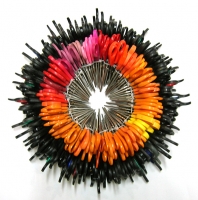
Agave plant is natures equivalent to the
shape of the scissor, pointy and weapon like, and for years have done artworks
with circles, it was when she was working on her thesis at Parsons that she
wanted to collaborate these things together.
Her
works are recognizable by the incorporation of circles and scissors. She uses
these two tactics to create pieces for clothing, accessories, wall hangings,
flat-pieces, and sculptures.


Carrie Mae recently
began working on a new style of artwork this past September during her Artist
Residincy at Eyebeam Art & Technology Center, which includes technology and
electricity along with her Wearable Weapons. She has taken Violet Wands- which
are electro medical devices used for the application of low current, high
voltage, electricity to the human body, and created wearable collars in which
the Violet Wands are placed. These Violet Wands are most popular in use for
sexual stimulation toys, healing tools for the body, used to provoke rather
than harm, and are sold both to the police department and S&M community.

Carrie Mae’s artist statement for the incorporation of including Violet Wands
into her Wearable Weapons collection explains how and why she chose to do this
project. “Wearable Weapons pioneers the use of technology for a serious of interactive
collars that are Violet Wands hacked and connected to OS Software to pulse
electricity to the beat/pitch of music and can be used for either a sculptural
installation or worn by an entertainer.”
The second artist I
chose to research is Tahir Hemphill, a fellow from Eyebeam 2009-2010. Tahir is
most interested in the studies of hip hop, the music, the history, the artist,
and the lifestyle. Unlike Carrie Mae’s many different mediums, Tahir’s main
focus is digital media and technological multimedia. He has implemented design
solutions for many big brands, including Verizon Wireless, Microsoft, Mercedez
Benz and L’Oreal.

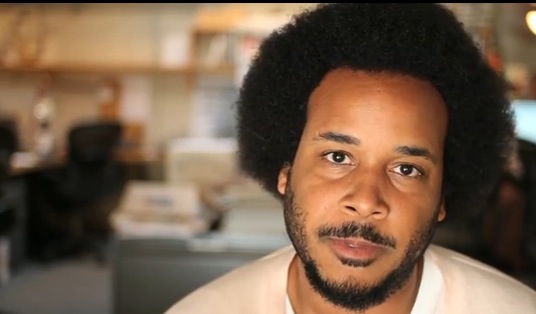
Tahir was raised by
a musical family and was groomed to be an engineer, having the intelligence and
drive to be a scientist, yet decided to take his talent and collaborate it all
together in the arts. Tahir’s educational background proves his ability and
eagerness to be knowledgeable. He has a Regents Diploma from Brooklyn Technical
High School in Electrical Engineering, a B.A degree in Spanish Language and
Minor in Mathematics from Morehouse College, and a M.S degree in Communications
Design from Pratt Institute. Amidst his studying at the Pratt Institute, Tahir
authored and designed the book Visual Alchemy, a work on traditional advertising
techniques to promote campaigning in an anti-consumerist or pro-social style.
For the past 4
years, and while working at Eyebeam, Tahir has worked on his biggest digital
media and hip-hop integration project yet. This project is called The Hip-Hop
Word Count, a rap almanac designed as a searchable database built up of lyrics
from over 50,000 hip-hop songs over the past 30 years. The web page is set up
in three different browser types: Map View, Graph View, and Song View. In these
different views the user can search interesting statistics about the songs, the
geographic location for every metaphor, simile, cultural reference, phrase,
rhyme style and socio-political idea used in the past 30 years of hip-hop. Not
only does this inform users of statistical information of rap songs and lyrics,
it is educating people about the history and culture of hip-hop.


The
Hip-Hop Word Count was featured in the MoMa’s “Talk To Me” exhibition this past
summer. The Creators Project also recognized Tahir for the Hip-Hop Word Count.
In an interview for The Creators Project, Hemphill spoke about his inspiration
for taking on this big project. “I was inspired by a general trend that I
observed in modern commercial rap music of an oversimplification of language. I
had the suspicion for a while, but then I started hearing this same commentary
show up in lyrics of the rappers themselves.” Tahir observed that these days,
rapping with lyrical skills of intricate vocabulary and poetical finesse is not
what is selling; it just isn’t as “cool”.
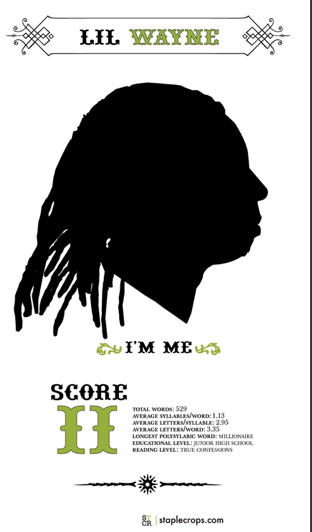
I
believe that hip-hop is a big part of today’s modern culture, and a dominant
subculture in the United States especially. This project takes the familiar,
hip-hop music, and makes the user/viewer search more in depth and from a
different angle. To investigate hip-hop deeper, on an educational,
geographical, grammatical, and ethnographical level makes the viewer engage
through design and art and interact with hip-hop in a new way. Users leave this
experience with a new understanding and appreciation for hip-hop music and
hip-hop artists and the hip-hop culture on a grand scale.
Carrie
Mae Rose brought attention to familiar items, such as scissors, and brought it
to the world of art in many different mediums. Seeing scissors worn as clothes
and accessories or sculpted in a gallery raises awareness to the different ways
of viewing items, how they can stand for more than just what they are used for,
in Carrie Mae’s case these scissors express vulnerability. These two artists
are very different in their styles and their specific project types; however,
they both strive to bring awareness to society about unfamiliar phenomenon
brought about through familiar things.